Our technology
No terminal, no crane — it does not get simpler.
A clear run for trailers on rail: the trailer wagon is the fast, simple and flexible way to move every type of truck trailer over long distances by rail.
Request a quote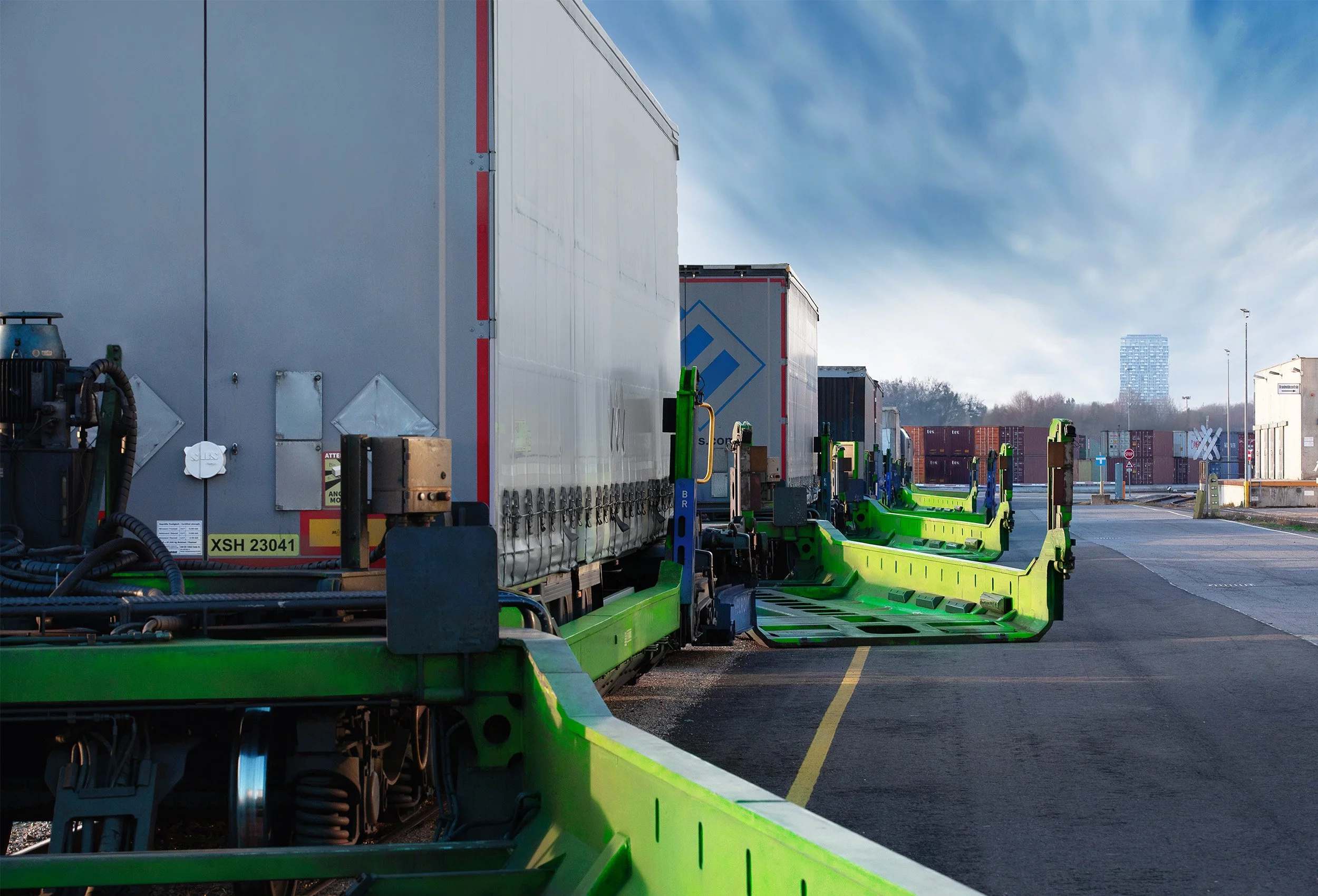
Innovative and barrier-free
A simple principle
The haulier drives the semi-trailer to the loading hub. The trailer is uncoupled from the tractor unit, the trailer wagon swings open at the side, the trailer is pushed onto the wagon, the wagon closes again — done. With the pivoting loading pocket, a trailer is on rail in about two minutes.
At the destination the same steps run in reverse: unload, couple to a tractor unit, drive the final mile. Nothing is lifted from above — so there is no sorting of trailers into craneable and non-craneable.
No expensive loading terminals, no cranes and no craneable semi-trailers are required. That is how 100 per cent of all truck trailers get onto rail without major outlay — refrigerated trailers included.
Without terminals
A transport technology that needs no special installations
Until now, loading craneable and non-craneable truck trailers alike required costly transhipment facilities that take years to build and a great deal of capital. Conventional approaches also lock route planning in place for the long term: a specialised terminal costing millions cannot be moved when supply chains shift.
It is precisely this barrier that has kept all but a very small share of semi-trailers off the railway. Barrier-free loading makes elaborate specialised terminals a thing of the past — and makes combined road and rail transport quick and simple to put into practice.
The loading point
What a loading hub actually needs
A loading hub can be set up anywhere there is a track, a level surfaced area beside it and a parking area for trailers. Nothing more is needed in fixed infrastructure.
That puts the transhipment point where the freight already is — at the plant, at the supplier, in the industrial estate — instead of at the nearest specialised terminal. And if the supply chain moves, the loading point can move with it.
- 100%
- of all truck trailers can be loaded — including non-craneable ones.
- 2%
- of all trailers travel by rail today.